
What Are You Looking For?
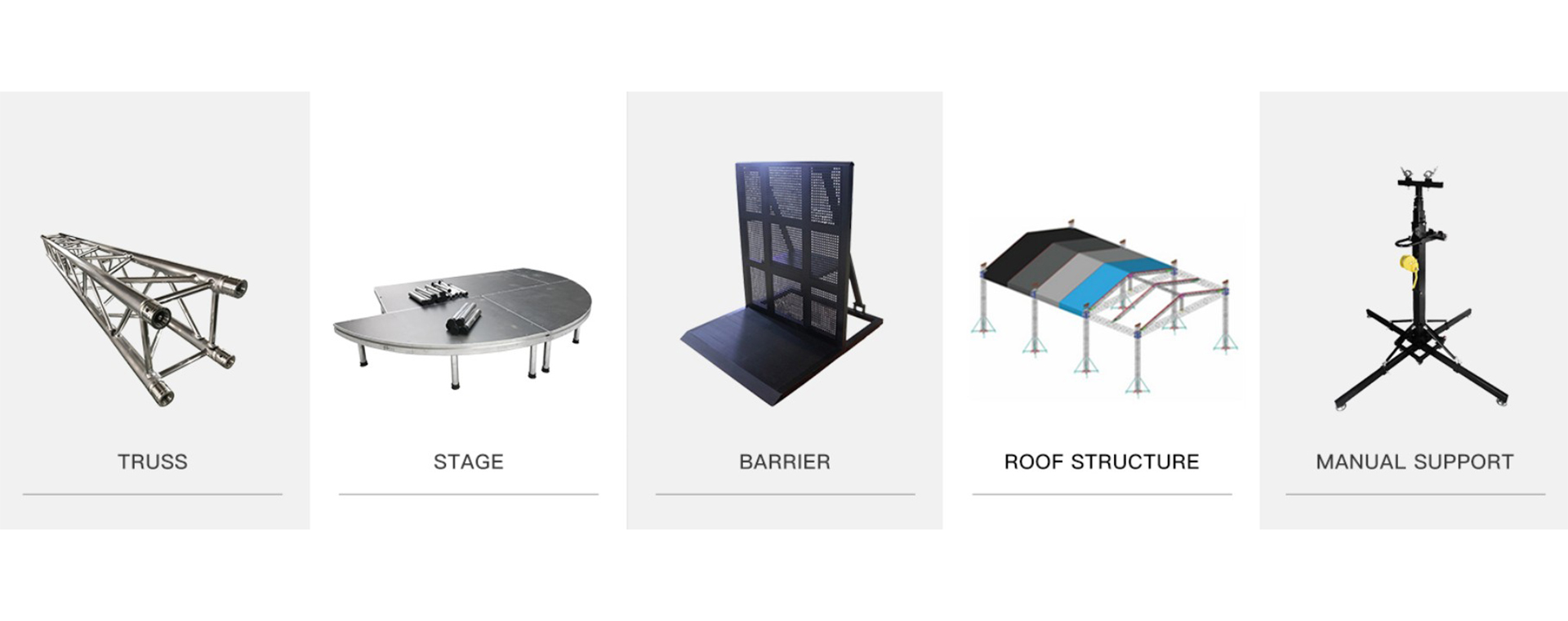
Aluminum Lighting Trusses are essential in stage and event setups for supporting lights and equipment.
Lighting trusses are structural frameworks used to support lighting fixtures, speakers, video screens, and other production equipment for events, concerts, theaters, and installations. They come in various types primarily distinguished by their cross-sectional shape and structural design, each suited to different applications, load capacities, and aesthetic needs.
Below a breakdown of the main types:
Box Truss (Square Truss):
Structure: Features a square or rectangular cross-section formed by four chords (top, bottom, and two sides) connected by diagonal and/or vertical webs (lacing). This creates a closed, box-like structure.
Characteristics: Offers the highest strength-to-weight ratio and torsional rigidity (resistance to twisting) among common truss types. Excellent for spanning large distances and handling heavy point loads.
Common Sizes: 200*200mm/290*290mm/400*400mm/520*520mm (referring to the width/height dimension).
Applications: Overhead rigging (main lighting positions, flown arrays), large stage roofs, heavy speaker hangs, structures requiring maximum strength and stability. The most versatile and widely used type for professional applications.
Triangular Truss:
Structure: Features a triangular cross-section formed by three chords connected by diagonal webs. The chords are typically arranged with one at the top and two at the base.
Characteristics: Strong and lightweight, though generally not as rigid torsionally as box truss. Easier to handle and rig than larger box truss. Often has a lower profile.
Common Sizes: 290*290mm/400*400mm (referring to the base width or height).
Applications: Touring applications (lighter weight), ground-supported towers, delay towers, roof structures, scenic elements. Popular for its balance of strength and portability.
Ladder Truss:
Structure: Features a simple, open cross-section resembling a ladder. Typically consists of two parallel top chords and two parallel bottom chords connected by vertical or near-vertical webs (rungs). Lacks diagonal bracing within the cross-section.
Characteristics: Lightest and least expensive type. Easy to handle and assemble. Offers good strength in the vertical plane but has very low torsional rigidity and lower load capacity compared to box or triangular truss. Primarily designed for ground use or very low-height flown applications with minimal load.
Common Sizes: 290mm/400mm (referring to the height/depth of the truss section).
Applications: Ground-supported structures (goal posts, small roof structures, trade show booths), cable bridges, lightweight scenic elements, very low-overhead applications with minimal lighting. Not suitable for significant overhead rigging.
Circular Truss (Pipe Truss, Curve Truss):
Structure: Features a circular or near-circular cross-section. Can be constructed similarly to a box truss but bent into a curve, or sometimes built using a lattice of tubes forming a circular profile.
Characteristics: Primarily chosen for its aesthetic shape rather than maximum structural efficiency. Allows for creating smooth curves and circles. Load capacity varies significantly depending on the specific design and diameter.
Common Sizes: Defined by diameter (e.g., 12", 16", 20", 24", 30", 40", etc.).
Applications: Creating circular lighting rigs, curved scenic elements, archways, circular video screens, installations where a curved shape is desired.
Key Factors Influencing Choice Beyond Type:
Material: Almost all modern event truss is made from aluminum alloy (typically 6061-T6 or 6082-T6) for its excellent strength-to-weight ratio and corrosion resistance. Older or very heavy-duty industrial truss might be steel.
Ground Support vs. Flown: Some truss types (especially ladder truss) are primarily designed for ground support using towers or legs. Box and triangular truss are commonly used both flown (suspended from ceilings/structures) and ground-supported. Always check manufacturer specifications and load ratings.
Load Rating: Critical factor! Truss is rated for UDL (Uniformly Distributed Load) and MPL (Maximum Point Load). Exceeding these ratings is extremely dangerous.
Accessories: Corner blocks, spigots, base plates, casters, hoists, and clamps are essential for assembly, support, and rigging.
In summary: Choose Box Truss for maximum strength and overhead rigging, Triangular Truss for a good balance of strength and portability (especially touring), Ladder Truss for simple ground-supported structures, and Circular Truss when a curved aesthetic is required. Always prioritize safety by adhering strictly to certified load ratings and using qualified riggers.



just let us know what you need. will reply you soon.
 IPv6 network supported
Hi! Click one of our members below to chat on